
Published · EastCamp product team
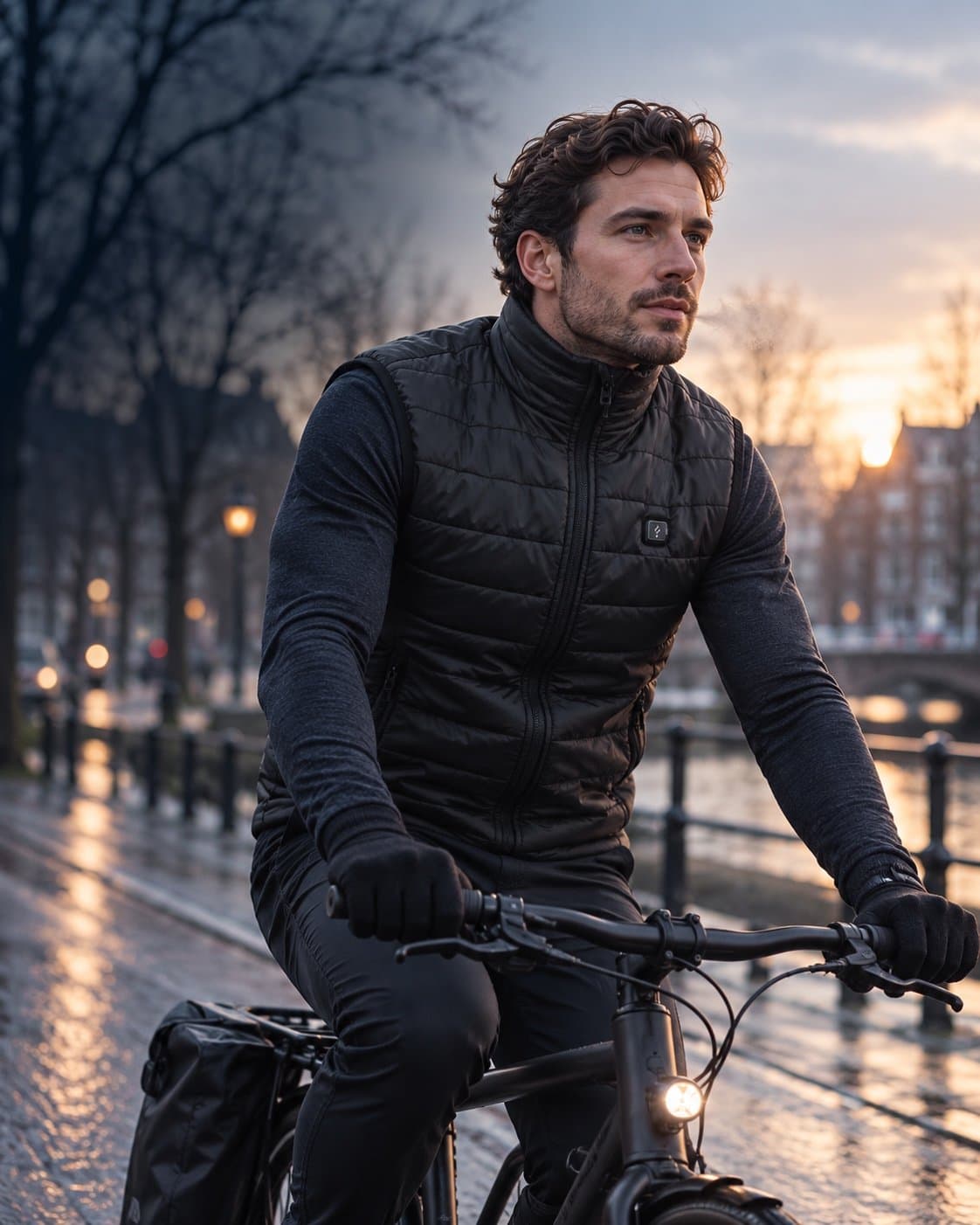
On a bike, your hands take the worst of the cold. They sit still on the handlebars, catch all the headwind and barely move. A few miles at five degrees and your fingers feel stiff, even when the rest of you is warm. Heated gloves solve that, as long as you choose a pair that suits cycling.
In short
For cycling, choose a heated glove that is windproof, lets you brake and shift easily and has heating that runs along the fingers. Switch it on before you set off and turn it down on the way. For commuting, a glove with fingers is usually the most practical; if your fingers are always freezing, a mitten is warmer.
Why do your hands get cold so fast on a bike?
Three things come together:
- Headwind. Ride at 18 km/h (about 11 mph) and your hands feel a stiff breeze even on a still day. Moving air carries heat away much faster than still air.
- Little movement. When you walk, your hands swing and the blood keeps flowing. On the handlebars, they stay put.
- Your body protects your core. When you're cold, your body reduces blood flow to your hands and feet to keep your core warm. A cold core means colder hands.
An ordinary glove only holds on to the heat your hand produces. A heated glove adds heat, and on a bike that's exactly what's missing.
What to look for in heated cycling gloves
| What to look for | Why it matters on a bike | On the Urban models |
|---|---|---|
| Windproof | Headwind is the biggest heat thief | Hipora membrane: windproof, waterproof and breathable |
| Heating zone | Cold hands start in the fingers | Back of the hand and along the fingers |
| Braking and shifting | Feel at the levers is safety | Urban Classic has separate fingers |
| Insulation | Keeps the heat in | 3M Thinsulate |
| Touchscreen | Check your route or a message without taking them off | Yes, on the Urban Classic and Urban Mitten |
| Battery | Where does it sit and how much energy does it hold? | 7.4V battery in the cuff, 18.5 Wh per battery |
Windproof beats thick
A thick glove without a windproof layer feels warm in the shop, but on the bike the wind blows straight through it. So look for a membrane or windproof outer first, and only then at how thick the insulation is.
You need to be able to brake and shift
On a bike, feel at the levers is not a luxury. A glove with fingers gives the most grip and precision. In a mitten you brake with your whole hand; on a town bike with a coaster brake or simple hand brakes that usually works fine. If you shift a lot or ride a road or mountain bike, you'll want separate fingers.
A glove that's too big slides around on the levers. One that's too tight restricts blood flow and actually gets colder. So measure your hand (see below).
The heat has to reach your fingers
When cycling, your fingertips get cold first. A glove that only heats the back of the hand feels nice when you set off, but halfway through the ride you'll notice the difference. On the Urban models, the heating runs over the back of the hand and along the fingers.
Gloves or mittens for cycling?
- Glove with fingers (Urban Classic): more feel at the brakes and gears, easier to handle a lock, keys or bell. The obvious choice for a daily commute.
- Mitten (Urban Mitten): your fingers lie side by side and keep each other warm. Great if your fingers are always cold and you mostly ride straight to work or into town.
Not sure? Our guide heated mittens or gloves? sets out the differences.
How to use heated gloves on the bike
- Charge the batteries at home, indoors at room temperature. Charge them between 5 °C and 40 °C, with a CE-marked 5V 2A USB-C charger.
- Switch the heating on before you set off. The gloves start in boost (the button flashes red) and switch to the medium setting by themselves after about five minutes. That way you start warm instead of warming up when you're already cold.
- Turn down once it feels comfortable. After a mile or two you need less heat. A lower setting saves the battery, so you still have heat on the way home.
- Use the button at a quiet moment. Set the level before you ride into traffic, not at a junction.
- Switch them off when you arrive and take the batteries out when you charge them.
How long a charge lasts depends on the setting, the temperature and the wind. For each model, the runtime per setting is listed as a guide in the specifications on the product page. Planning a long ride? Bring a second battery set and keep it in an inside pocket.
Rain, wind and darkness: practical tips
- Sleeves over the cuff. Even a waterproof glove can fill up through the opening at the wrist. Let your rain jacket fall over the cuff.
- Wet inside? Don't heat. If the gloves are wet on the inside, take the batteries out and let them dry completely before using them again.
- Keep your core warm. An extra layer on your upper body helps your hands more than you'd think. A heated vest under your jacket is one option.
- See and be seen. In the dark, an outstretched hand is hard to spot when you signal. Good bike lights and reflective details on your jacket make the difference.
Alternatives: bar mitts or heated grips?
There are other ways to keep your hands warm on a bike. Bar mitts (wind covers that fit over your handlebar ends) block the wind and work well on a town bike, but you keep sliding your hands in and out. Heated grips exist mainly for e-bikes and only warm the inside of your hand; the back of your hand and your fingertips stay in the wind. A heated glove warms the whole hand and comes with you, even when you get off and walk.
Ride a motorbike or scooter? Different requirements apply. Read heated gloves on a motorbike.
The right size for cycling
Measure the circumference of your hand over the knuckles, without the thumb. On every glove page you'll find the size guide next to the size selector, from about 19 cm (XS) to 24 cm (XXL). If you're between two sizes, choose the larger one so the glove doesn't pinch around the bars. If you ride with a thin liner glove, allow for that when you measure.
Care after a wet ride
- Take the batteries out of the gloves first.
- Clean them only with a damp cloth; no washing machine and no soaking.
- Let them dry at room temperature, not on a radiator, and don't fold them double.
- Only put the batteries back once they're completely dry.
Our heated gloves for cycling
The Urban Classic is made for the ride to work and a day in town: a glove with fingers in PU leather (vegan leather) with stretch, touchscreen-compatible, waterproof and windproof, with the battery in the cuff close to the wrist. Prefer the warmth of a mitten? Go for the Urban Mitten. Both use the 7.4V battery set. You'll find every model under heated gloves.
Want to know more about batteries, heat settings and safe use? Read the complete heated gloves buying guide. If your fingers turn white or numb in the cold, read heated gloves for Raynaud's too.
Frequently asked questions
- How do I keep my hands warm when cycling?
- Stop the wind first: a windproof glove does more than a thick one. Switch heated gloves on before you set off so you don't start cold, and keep your core warm with an extra layer. Let your jacket sleeves fall over or close snugly around the cuff so cold air can't blow in at the wrist.
- How does a heated glove work?
- A rechargeable battery in the cuff sends a low voltage through thin, flexible heating elements inside the glove. They warm up and pass that heat to your hand. A button lets you choose the setting, and insulation plus a closed outer layer keep the heat in.
- Which gloves really keep your hands warm on a bike?
- It's the combination that counts: windproof, waterproof, insulated and actively heated. If your fingers get cold quickly, a mitten is warmer than a glove with fingers. If you shift a lot and want precise braking, choose fingers.
- Can you brake safely in heated gloves?
- Yes, as long as they fit well. A glove with fingers gives you the most feel at the brake levers. Try a new pair on a quiet road first, and set the heat level before you leave, not in the middle of traffic.
- Why do cyclists wear gloves?
- For grip on the bars, to protect the palms in a fall and, in winter, against cold and wind. Road and mountain bikers usually wear thin, close-fitting gloves; for a winter commute you can go warmer and thicker.
- What should you do if your gloves get wet?
- A waterproof outer keeps rain out, but water can run in at the cuff, so let your sleeves fall over it. If the gloves are wet on the inside, don't use the heating: take the batteries out and let the gloves dry completely.