
Published · Updated · EastCamp product team
In short
Heated clothing runs on a small lithium battery or a power bank at a low voltage, between 3.7 and 7.4 volts for our products. Compare batteries by watt-hours (Wh), not just mAh: that is the energy actually inside. How long you stay warm depends on the setting, the temperature, wind and the age of the battery. Charge with a CE-marked charger, never unattended, and stop straight away if a battery gets hot or deforms.
The battery is the heart of every heated garment. It determines how warm it gets, how long that lasts and how you handle it. In this guide we explain how it works, using the data of our own products as examples.
What batteries are in heated clothing?
You will see three types:
- Separate battery packs that slot into a pocket, as with gloves and socks. Ours are lithium polymer batteries.
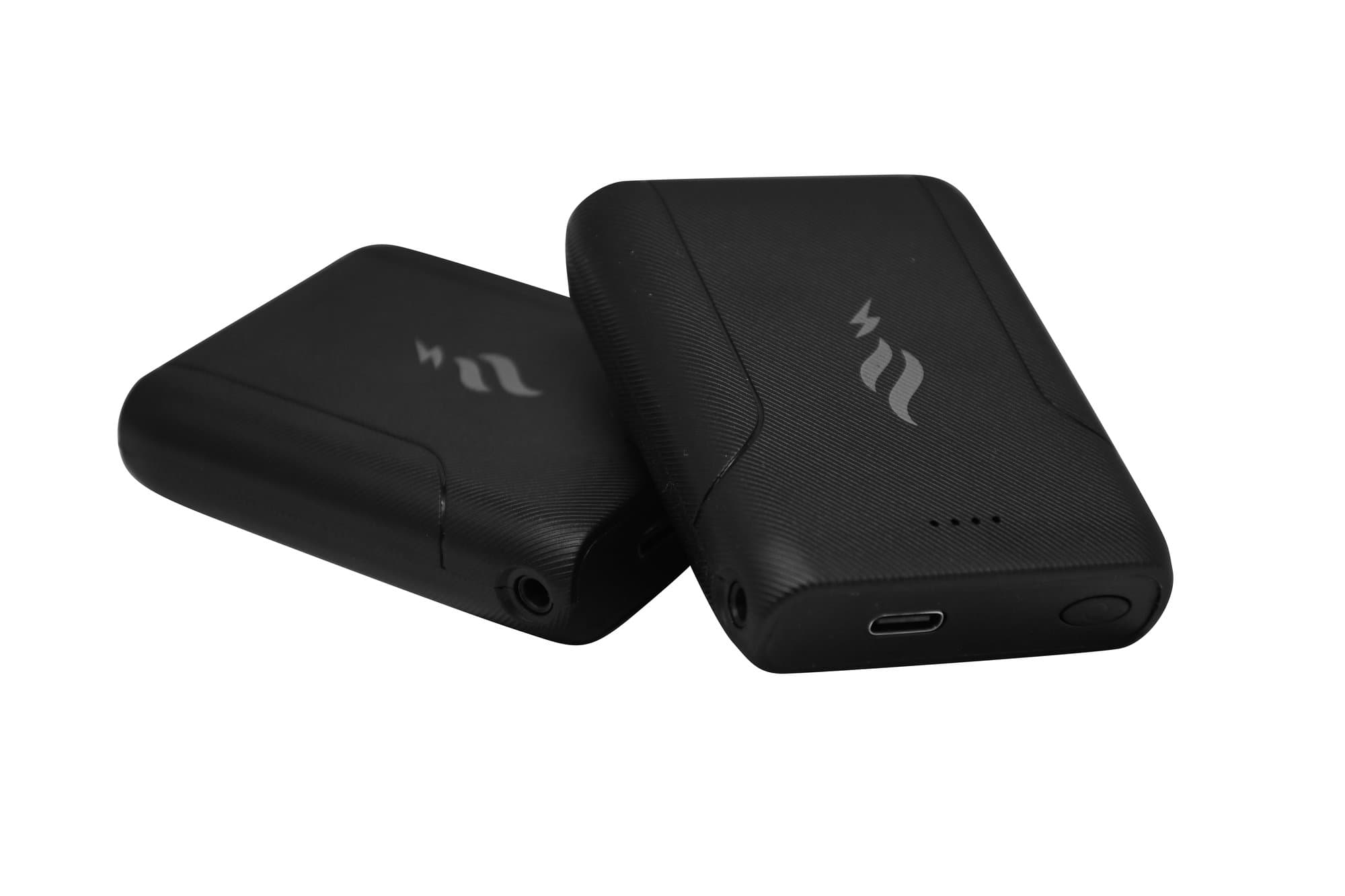
- A power bank in a pocket, as with vests and jackets. A power bank can usually charge your phone too.
- A built-in battery, as in our heated insoles. You then charge the whole product.
How many volts and watts does heated clothing use?
Volts (V) are the voltage. Heated clothing runs on a low voltage. A higher voltage allows more power in a small garment, but only if the product is made for it. So always use the battery that belongs with your product.
Watts (W) are the power: how much energy the product uses. Our Puffer Vest has a rated input power of 10W at 5V. On a lower setting it uses less.
Watt-hours (Wh) are the energy stored in the battery. You calculate it by multiplying the capacity in amp-hours by the voltage: Wh = Ah × V. A 2,500 mAh (2.5 Ah) battery at 7.4V therefore holds 18.5 Wh.
Why watt-hours are fairer than mAh
mAh only tells you something when the voltage is the same. An example from our own range: our 5V battery has 3,000 mAh, our 7.4V battery 2,500 mAh. Yet the 7.4V battery holds well over one and a half times as much energy: 18.5 Wh against 11.1 Wh.
Which battery goes with which product?
| Product | Battery | Data | Charging time |
|---|---|---|---|
| Urban Classic, Urban Mitten | 7.4V battery set (2 batteries) | 7.4V · 2,500 mAh · 18.5 Wh per battery | max. approx. 5 h |
| Alpin, Velvet (back in stock soon) | 5V battery set (2 batteries) | 5V · 3,000 mAh · 11.1 Wh per battery | max. approx. 5 h |
| Heated Socks | 2 battery packs, included | 3.7V · 2,200 mAh · 8.14 Wh | max. approx. 8 h |
| Heated Insoles | Built in | 3.7V · 1,800 mAh | max. approx. 5 h |
| Puffer Vest | Power bank, as a bundle with the vest or separately | 5V · 10,000 mAh; vest 10W | approx. 3–4 h (20W adapter) |
Everything charges via USB-C. The glove batteries last more than 500 charge cycles, those of the socks and insoles more than 300.
How long does heated clothing stay warm?
That depends on:
- the setting. Boost and high use the most. If you use boost often, you will notice it on the other settings.
- the outside temperature, wind and moisture. The colder and wetter, the harder the heating works.
- how full and how old the battery is. An old or half-charged battery lasts less long.
- how well the warmth stays in. A windproof layer on top makes a big difference.
For socks and insoles we give an indication, measured at 20 °C:
| Setting | Heated Socks | Heated Insoles |
|---|---|---|
| High | ± 4 hours | ± 2.5 hours |
| Medium | ± 5.5 hours | ± 4 hours |
| Low | ± 8 hours | ± 7 hours |
In the cold it is shorter. For the gloves, the run time per setting is given as an indication in the specifications on the product page, per battery set. For the vest we do not give a fixed number of hours: it depends strongly on the power bank and the setting.
Want to save energy? Warm up on a high setting, then switch down to a setting that just feels comfortable. On a long day, take a spare battery or second power bank and keep it warm in an inside pocket.
How do you charge the battery?
All our products charge via USB-C. A few rules from the manuals:
- Fully charge a new battery before first use.
- Use the supplied cable and a CE-marked USB charger (5V, at least 2A).
- Do not charge unattended and not near flammable materials.
- Do not charge when the battery is damaged, deformed, wet, warm or very cold. For the glove batteries: not below 5 °C and not above 40 °C.
- Disconnect the battery once it is full. On the glove batteries the lights flash while charging and all stay lit when the battery is full.
How do you make a battery last?
- Store it half full. Charge it to about half before summer and store it somewhere dry and cool.
- Top it up at least every three months. A battery left completely empty or completely full for a long time deteriorates faster.
- Avoid heat and severe cold when not in use. Do not leave it in the sun or on a radiator.
- Take the battery out when you wash, transport or do not use the product for a long time.
Our batteries keep at least 80% of their original capacity after 12 months; that is covered by our warranty. Is the run time 40% shorter than at the start? Then the manual advises you to stop using that battery and replace it.
Is heated clothing safe?
Yes, if you use it as intended. Lithium batteries are safe when used properly, but incorrect use can lead to overheating, fire or burns. From our manuals:
- Do not use heated clothing while sleeping, on children without supervision or together with other heat sources.
- Do not use it on people who cannot feel heat well or are oversensitive to heat. Do you have diabetes, circulation or nerve problems? Talk to your doctor first.
- Not on damaged or irritated skin, and not when the inside of the product is wet.
- Do not open, crush, puncture, short-circuit or burn batteries. Do not heat them above 60 °C and do not immerse them.
- Check your skin regularly during long use. Even warmth that feels comfortable can cause burns after long exposure.
- Stop straight away if you feel pain, tingling, redness, irritation or a burning sensation, and if a battery gets hot, deforms, leaks, smokes or smells strange.
Heated clothing not working: what now?
Go through these steps:
The product does not get warm
- Is the battery or power bank charged?
- Is the plug firmly connected? Check the cable in the battery pocket or the vest pocket.
- Did you hold the on/off button for a few seconds until the light comes on?
- Are the cables undamaged?
- With gloves: test the battery in the other glove. That tells you whether it is the battery or the glove.
- With the vest: does another suitable power bank (5V, at least 2A) work?
The run time is shorter than expected
You are using a high setting or boost often, it is very cold, wet or windy, or the battery is not full or is ageing. With a power bank, a low capacity can also be the cause.
The battery does not charge
Check that the cable is firmly connected, that the USB charger works and that the connection is clean and dry. If the battery is damaged, do not use it any more.
Still not working? Contact us. You have a 24-month warranty on material and manufacturing defects. Keep your proof of purchase.
Can a battery or power bank go on a plane?
Usually yes, in your hand luggage and with rules on the number and the watt-hours. Separate batteries and power banks may not go in checked baggage. Everything is set out in taking a power bank on a plane.
What do you do with an old battery?
Not in household waste. Take old batteries and electronic parts to an official collection point. The full instructions per product are in the manuals.
Read on
- Heated vest buying guide
- Heated gloves buying guide
- Heated socks buying guide
- A separate power bank is in heated accessories; a battery set comes as a bundle with your gloves or separately.
Frequently asked questions
- Is heated clothing safe?
- Yes, if you follow the manual. Heated clothing runs on a low voltage, between 3.7 and 7.4 volts for our products. Only use the right batteries or a suitable power bank, do not charge unattended, do not wear the clothing while sleeping and stop if you feel pain, redness or a burning sensation. If you cannot feel heat well, for example because of diabetes, talk to your doctor first.
- My heated clothing is not working: what now?
- First check that the battery or power bank is charged and properly connected, that you held the on/off button for a few seconds and that the cables are undamaged. With gloves you can test the battery in the other glove. If that does not help, contact us; you have a 24-month warranty on material and manufacturing defects.
- How many volts does heated clothing use?
- Usually between 3.7 and 7.4 volts. At EastCamp the socks and insoles run on 3.7V, the vest and the Alpin and Velvet gloves on 5V and the Urban gloves on 7.4V.
- How many watts does a heated vest use?
- That differs per vest. Our Puffer Vest has a rated input power of 10 watts at 5 volts. On a lower setting it draws less.
- Why is my battery getting warm?
- A battery can get a little warm while charging and in use. If it becomes unusually hot, deforms, leaks, gives off smoke or smells strange, stop charging or using it immediately and do not use that battery again.
- Can I use a different battery or power bank?
- With our gloves, only the original EastCamp batteries. With the Puffer Vest, the EastCamp power bank or a CE-marked 5V USB-A power bank that delivers at least 2A. Always use a CE-marked charger.