
Published · Updated · EastCamp product team
In short
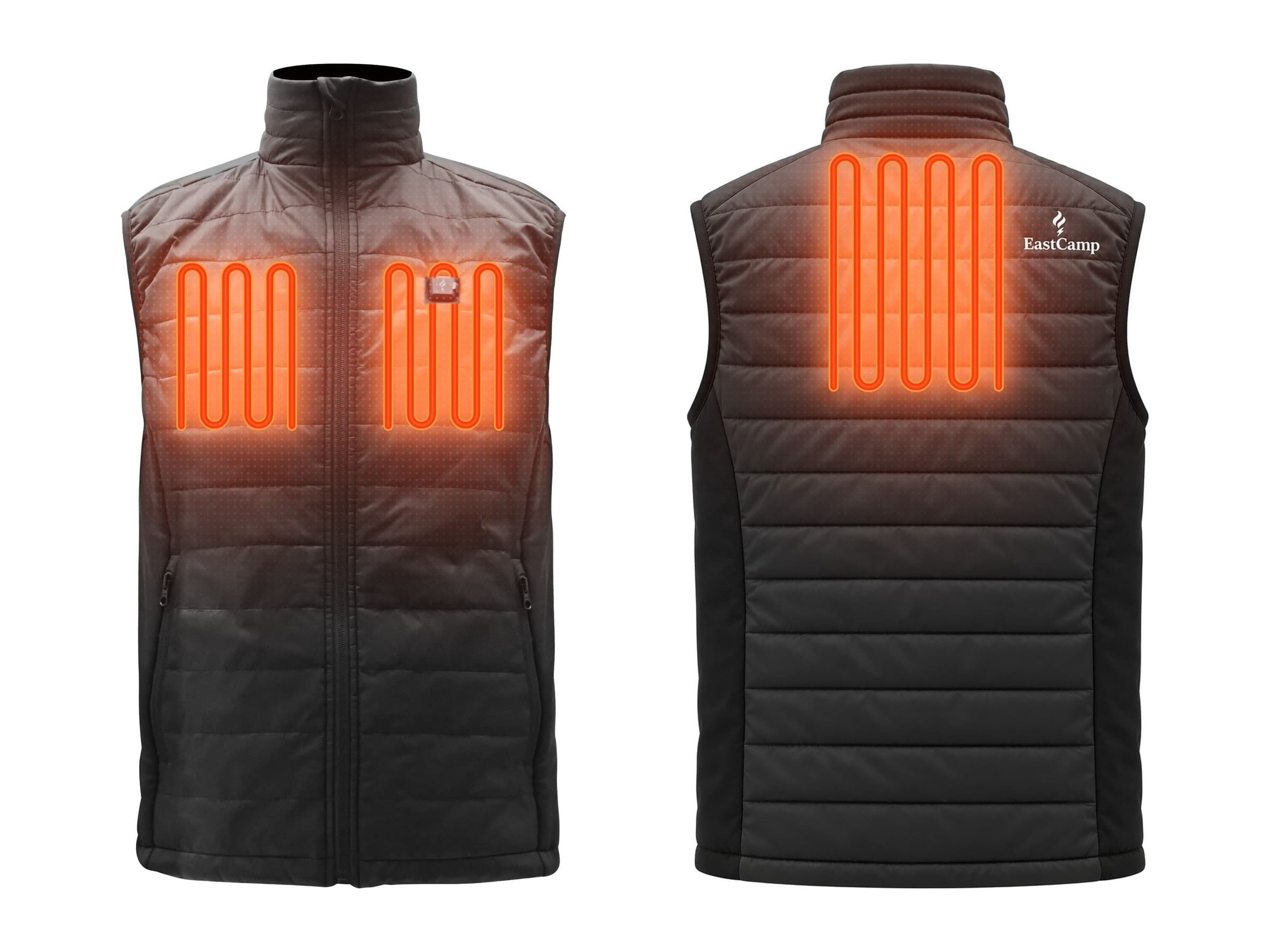
A heated vest, or heated gilet, is a sleeveless vest with heating elements powered by a power bank. Choose one with heat on both the chest and the back, several settings, a clear power bank solution and a fit you can wear over a thin layer and under a coat. Our Puffer Vest has three heating zones, three settings plus boost and runs on a 5V power bank, which you buy as a bundle with the vest or separately.
If you spend a lot of time outdoors but do not want to wear a heavy winter coat all day, a heated vest makes a real difference. Your core stays warm and your arms stay free. In this guide you will find what to look for. We are a Dutch brand with a team that has worked in this market for more than ten years, so we will also tell you honestly what a vest does not do.
How does a heated vest work?
Thin, flexible heating elements sit in the lining. At EastCamp they are made of composite fibre. A power bank in one of the pockets supplies power at a low voltage. The elements warm up and pass that heat on to your body.
You switch the heating on and choose the setting with the heating button. Insulation keeps the warmth in. The difference with an ordinary body warmer: that only holds on to the heat you produce yourself. A heated vest adds warmth, even when you are standing still.
Why the core? When your body cools down, it protects the organs in your torso first. Your hands and feet then get less warm blood. A warm core is therefore a good basis for the rest of your body. A vest does not replace gloves or socks, but it does help.
Where are the heating zones?
Look first at how many zones there are and where they sit. Many vests only heat the back, or only the chest. Heat on both feels more even.
Our Puffer Vest has three heating zones: left chest, right chest and the centre of the back. More zones is not automatically better. What matters more is that the warmth sits where you get cold, and that the vest fits closely enough for the zones to actually rest against your body.
How many heat settings do you need?
At least three. On a cold morning you want warmth fast; after fifteen minutes of walking you need much less. Switching down stops you from sweating and makes your power bank last longer.
This is how it works on the Puffer Vest:
- When you switch the vest on, it starts in boost: the button flashes red.
- After about five minutes it switches to the middle setting (orange) by itself.
- After that you choose: high (red), medium (orange) or low (blue).
- Boost only works if the vest was switched off first. Use it briefly, to warm up.
Useful if you wear the vest under a coat or at work: Ghost mode turns off the button light. The heating stays on and you can still change settings. You do this with the small button on the side of the heating button.
What power bank do you need?
A heated vest has no built-in battery but runs on a power bank. Look at three things: the voltage, how much current the power bank can deliver and the connection.
| Puffer Vest | |
|---|---|
| Voltage and power | 5V / 10W |
| Power bank | EastCamp 5V 10,000 mAh PD, available as a bundle with the vest or separately |
| Other power bank | CE-marked, 5V, USB-A, at least 2A |
| Charging the power bank | Via USB-C in about 3–4 hours (with a 20W adapter, sold separately) |
| Power bank pocket | In one of the zipped front pockets |
If you already have a suitable power bank, you can also order the vest without one. An extra power bank is handy for a long day outdoors. You can also use the same power bank to charge your phone on the go.
If you use a different power bank, choose a reputable brand with CE marking that delivers at least 2A. A power bank with a low capacity, or an old one, keeps the vest warm for a shorter time.
How long does a heated vest stay warm?
That depends on the setting, the outside temperature, wind and moisture, how full the power bank is and how old it is. Boost and the highest setting use the most. That is why we do not give a fixed number of hours for the vest: it varies too much per situation and per power bank. Want to save energy? Warm up with boost, then switch down to low or medium and wear a jacket over the vest. Everything about capacity, charging and batteries is in our guide to heated clothing batteries.
What size should you choose?
A heated vest should fit closely so that the heating zones sit near your body. A vest that hangs loosely mostly warms the air in between.
The Puffer Vest comes in sizes XS to XXXL. Choose the size you would take in an ordinary body warmer, with room for a thin layer underneath. Torn between two sizes, or want to wear the vest over a thick jumper? Please contact us and we will help you choose.
Stretch side panels (93% polyester, 7% elastane) let the vest move with you when you cycle, lift or reach.
How do you wear a heated vest best?
The smartest way is in layers:
- Base layer: a thin long-sleeved top. Not directly on bare skin.
- Heated vest: close-fitting, with the power bank in the pocket.
- Outer layer: a jacket on top in wind, rain or severe cold.
Under a jacket the warmth stays in and you can use a low setting more often. On a dry, calm day you wear the vest as your outer layer. The outer fabric is 100% polyamide. Y-Warm insulation throughout the vest keeps the wind out and spreads the warmth evenly. The vest also has two zipped front pockets and a zipped inner pocket.
What do you use a heated vest for?
Cycling and commuting
On the bike, your core gets cold first because of the wind. A heated vest under your jacket is then more pleasant than an extra thick layer you start sweating in. Switch the heating on before you set off, so you do not have to warm up on the way.
Walking, the dog, the sidelines
When you stand still a lot, warmth on your core helps straight away. A vest is light, fits under a rain jacket and leaves your arms free.
Working outdoors
At the market, on a building site, in the garden or the warehouse: with a vest your arms are free to work. Note: our vest is not protective workwear and not high-visibility safety clothing. Read more in our guide to heated clothing for outdoor work.
Travelling
Flying? Then rules apply to the power bank. We list them in taking a power bank on a plane.
Heated vest or heated jacket?
A vest is more versatile: you wear it under any jacket, as a mid layer or on its own, and your arms move freely. A heated jacket is one complete garment, but you are tied to that one jacket. At the moment we sell the vest; our heated jackets are not available. The full comparison is in heated jacket or heated vest.
How do you wash and store a heated vest?
A heated vest contains electronics, so always follow the care instructions:
- Disconnect the power bank first and take it out of the vest.
- Hand wash only. No washing machine.
- No bleach, ironing, tumble dryer or dry cleaning.
- Dry flat and do not fold the heating elements double.
- No harsh cleaning agents or stiff brushes.
- Let the vest and the connections dry completely before you reconnect the power bank.
Putting the vest away at the end of winter? Charge the power bank to about half, and store everything somewhere dry and cool. Top up the power bank at least once every three months.
Is a heated vest safe?
Yes, if you use it as intended. From our manual, in short:
- Do not use the vest while sleeping or on children without supervision.
- Do not wear it directly on bare skin, or on damaged or irritated skin.
- Do not use it when the inside of the vest is wet, or when the fabric, cable, button or power bank is damaged.
- Do not combine it with other heat sources. Do not push pins or badges through it.
- If you cannot feel heat well, for example because of diabetes, circulation or nerve problems, talk to your doctor first.
- Stop straight away if you feel pain, tingling, redness, irritation or a burning sensation.
The full instructions are in the manuals.
Checklist: what to look for when buying
- Are the heating zones on both the chest and the back?
- Are there at least three settings, plus a boost to warm up quickly?
- Which power bank do you need, is it included and how do you charge it?
- Does the vest have its own closable pocket for the power bank?
- Does the vest fit over a thin layer and under your coat?
- How do you wash it, and how long is the warranty? With us: 24 months on material and manufacturing defects.
Our heated vest
The Puffer Vest is available now, in sizes XS to XXXL, as a bundle with the EastCamp 10,000 mAh power bank or separately. All heated clothing is in heated clothing.
Cold hands or feet? Then also read the heated gloves buying guide and the heated socks buying guide.
Frequently asked questions
- Do heated vests really work?
- Yes, as long as you wear them well. A heated vest adds warmth to your core, where your body holds on to heat first. It works best when it fits closely over a thin layer and you wear a jacket over it in wind or rain.
- What do you wear under a heated vest?
- A thin layer, such as a long-sleeved top or a light jumper. Do not wear the vest directly on bare skin; our manual says so too. Lots of thick layers underneath actually keep the warmth away from your body.
- How do you wash a heated vest?
- Disconnect the power bank first and take it out. Our Puffer Vest is hand wash only and must be dried flat. No washing machine, no bleach, no ironing, no tumble dryer and no dry cleaning. Let the vest dry completely before you reconnect the power bank.
- What power bank do you need for a heated vest?
- That depends on the vest. Our Puffer Vest runs on 5V and draws 10W. You can use the EastCamp 10,000 mAh power bank, which you buy as a bundle with the vest or separately, or a CE-marked 5V USB-A power bank that delivers at least 2A.
- Is a heated vest safe?
- A heated vest runs on a low voltage and is safe if you follow the manual. Do not use it while sleeping, when the inside of the vest is wet or together with other heat sources. If you cannot feel heat well, for example because of diabetes or circulation problems, talk to your doctor first.
- Can you wear a heated vest under a coat?
- Yes, that is one of its strongest points. Under a coat the warmth stays in and you need less power. Keep the power bank in the vest pocket so you can still reach the button to change settings.